Franz Kemmerich
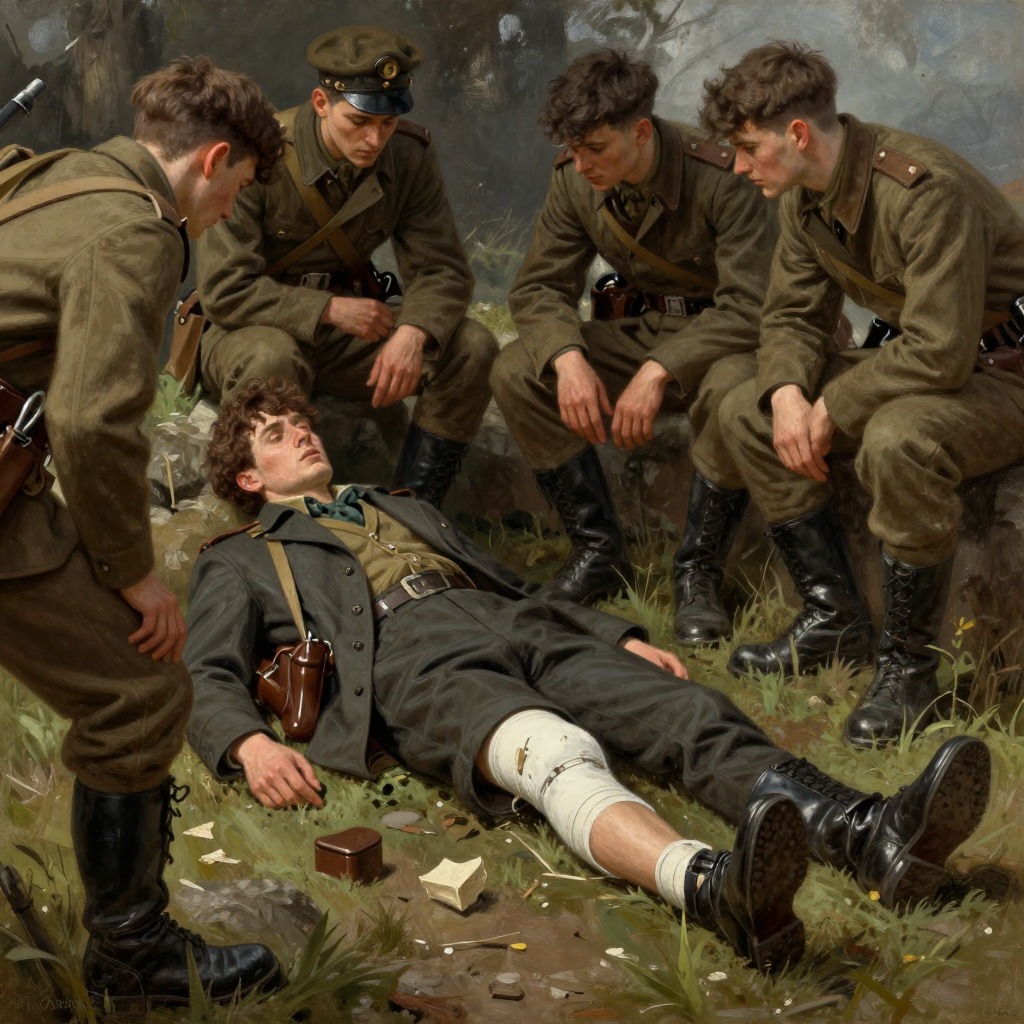
Franz Kemmerich is a young German soldier, a former classmate of Paul Bäumer, whose death from a leg amputation in a field hospital marks one of the novel's earliest and most intimate confrontations with the war's personal cost. His passing strips away the romantic illusions of combat and reveals the brutal mechanics of survival, where even a comrade's prized boots become a coveted asset before the body is cold.
Identity and Background
Kemmerich is introduced as one of the group of friends from the same school class who volunteered for the war under the influence of their schoolmaster, Kantorek. He is described as having a face like a child, with frail bones that gave him flat feet after only four weeks of pack-carrying. His mother, a plump matron, wept uncontrollably at the station when he departed, repeatedly imploring Paul Bäumer to look after him. At school, Kemmerich wore a brown coat with a belt and shiny sleeves, and he was the only one who could perform the giant's turn on the horizontal bar, his hair flying in his face like silk. Kantorek was proud of him. He could not stand cigarettes, his skin was very white, and he had something of the girl about him. When bathing, he looked as slight and frail as a child.
Wounding and Hospitalization
Kemmerich sustains a flesh wound in his thigh, which Müller initially describes as a good blighty. He is taken to St. Joseph's Hospital. When Paul, Müller, and Albert Kropp visit him, they find him in a large room that reeks of carbolic, pus, and sweat. While he was unconscious, someone stole his watch. His leg lies under a wire basket, and the bed covering arches over it. Paul kicks Müller on the shin to stop him from revealing what the orderlies have already told them: that Kemmerich's leg has been amputated. Kemmerich looks ghastly, yellow and wan, with the strained lines of approaching death already on his face. His voice sounds like ashes. Paul observes that the dirt under his fingernails shows through blue-black like poison, and he imagines the nails will continue to grow like lean fantastic cellar-plants long after Kemmerich breathes no more.
The Boots and the Watch
Müller is immediately interested in Kemmerich's fine English boots of soft, yellow leather that lace up to the knees. He asks if Kemmerich will be taking them with him, and suggests an exchange. Kemmerich does not want to part with them, as they are his most prized possessions. Paul treads on Müller's foot, and reluctantly Müller puts the boots back under the bed. Later, as Kemmerich sinks, he tells Paul to take the lace-up boots for Müller. Müller is thinking of them and means to be on the spot when Kemmerich dies. The watch, stolen by someone while Kemmerich was unconscious, is also a concern; in his final moments, Kemmerich whispers to Paul, "If you find my watch, send it home."
Death and Aftermath
Kemmerich's condition deteriorates rapidly. The doctor passes by his bed without once looking at him. Paul tries to comfort him with talk of convalescent homes and building an aquarium, but Kemmerich weeps. He knows he is dying. He whispers that he once wanted to become a head-forester. Paul attempts to reassure him about artificial limbs, but Kemmerich is beyond comfort. He dies while Paul is fetching the doctor, who is too busy amputating legs to attend. The orderly tells Paul that Kemmerich is the seventeenth death that day. Paul collects Kemmerich's things and unties his identification disc. The orderly asks about the paybook. Behind him, they are already hauling Franz onto a waterproof sheet. Müller gets the boots, and they fit him well. Paul must write to Kemmerich's mother, a task he dreads. When he later visits her on leave, she is inconsolable, demanding to know how her son died. Paul lies, saying he died instantly and without pain, swearing to it by everything sacred to him.
Thematic Significance
Kemmerich's death is a pivotal early lesson for Paul and his comrades. It shatters the abstract patriotism they were taught and replaces it with the raw, physical reality of loss. The episode starkly illustrates the war's reduction of human life to a calculus of material value: the boots are more immediately useful to the living than to the dying. Paul's internal monologue as he sits by Kemmerich's bed—"The whole world ought to pass by this bed and say: 'That is Franz Kemmerich, nineteen and a half years old, he doesn't want to die. Let him not die!'"—captures the profound, helpless grief that undercuts all official rhetoric. Kemmerich is the first of Paul's close friends to die, and his passing marks the beginning of the emotional numbing and pragmatic survival instinct that will define the soldiers' existence.